Photography preserves the parts of life that are still mine: people, coffee, movement, nature, projects and moments when the world briefly fits.
It also helps when words disappear or are ignored. A photograph cannot prove an entire case, but it can hold a date, a threshold, a bruise, an inaccessible room or a workaround long enough for me to rebuild the route around it.
This chapter is my account of the present. Live disputes remain live; the Public Timeline and controlled Clerical Audit Ledger hold the source records and provenance.
Part one
Returned to the Fire
I returned with a clearer brain, but not to a clearer system. Silence, automatic replies and inaccessible accommodation pushed me straight back towards survival mode.
01
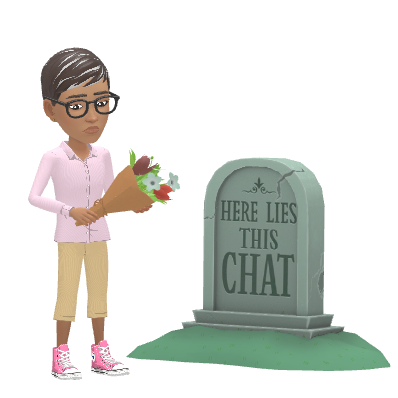
Here lies this chat
Some people stopped responding. Others sent replies so automatic that they appeared not to have read what I had written. An aunt might say, “I’ll call when I get home,” then never follow up. One response was so disconnected that I asked whether she was joking.
For me, that pattern can function like gaslighting: the words perform connection while the missing follow-through erases the communication that actually happened. Eventually, ignoring the empty exchange used less energy than trying to repair it again.
02
I can own my reactions without carrying all of it
My meltdowns and the resulting loss of credibility affected relationships and the way people interpreted me. I accept that. Accountability matters.
But accepting my part does not make every assault, inaccessible room, unanswered message or administrative failure imaginary. Some people are arses. Public bodies with duties should not make repairing credibility harder by adding avoidable barriers and repeating inaccurate accounts.
03
Back because the system ordered it
By February 2025, redundancy and unresolved benefit payments had made my self-funded Cornwall arrangement impossible to sustain. SMBC had told Cornwall that two accessible homes had been offered to me. My position is that neither offer was made, and Elizabeth Deegan’s correction was ignored.
I was told to return to Sandwell. I arrived at Manifoldia Grange for the second time and was immediately thrown back into survival mode.
04
Long time, no new answer
I caught up with friends I had not seen while living in Cornwall. Some older friendships had faded because “nothing has changed” stopped being an interesting answer years ago. New friends were left wondering whether my story was real, exaggerated or a delusion.
Seeing people still mattered. Face-to-face connection gives me information that text cannot. A good reunion did not resolve the situation, but it reminded me that I existed outside it.
Part two
Accessible on Paper
Manifoldia Grange was described as accessible. My body, chair and TriRide encountered a different property.
05
Every ordinary task became the job
Trying to clean Manifoldia Grange was almost impossible. Cooking was dangerous and awkward because the glass cooker door sat beside the corner of the sink. Whenever I moved my chair near the sink, it struck the glass door.
I could not cook, shower or use the toilet safely. The accommodation did not reduce my support needs; it manufactured more work around every basic task.
06
When does “accessible” become usable?
At first, staff insisted the property was accessible. They later acknowledged that it was not, while aids and adaptations were refused on the basis that an accessible property should not need them.
During a later mental-health assessment, I was told that aids and adaptations could be supplied after all. The answer changed with the audience; the barriers remained in place.
07
Stuck in—or stuck out
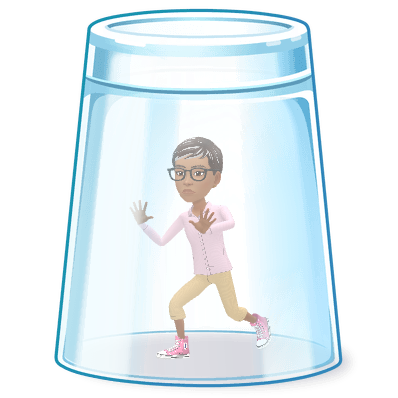
The door threshold was so high that even my TriRide struggled to move equipment across it. Grass immediately outside added another barrier. Both entrances were inaccessible.
Depending on which side of the door I occupied, I could be trapped inside the property or stranded while trying to get back in with unreliable equipment. On a form, these were small details. In a body, they controlled whether I could leave and return safely.
08
Solicitors left the night shift with me
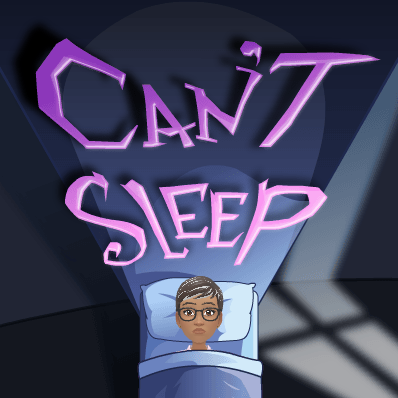
Insomnia has been a regular companion for more than a decade. I had explicitly instructed my solicitors to ask the court whether I could await trial on remand because I had nowhere safe or accessible to go. That instruction was not acted upon. I was sent to Manifoldia Grange instead.
The solicitors did not reduce the housing, court, evidence or communication burden; their inaction added to it. Sleep cannot be ordered into existence while one nervous system is left guarding every route in and out.
Part three
Game Over, Then Back
After six weeks of shifting rules and incompatible instructions, leaving became an autistic survival response. Court meant I still had to return.
09
The rules changed after every move
For six weeks, the account kept changing: accessible, not accessible, no adaptations required, then adaptations available. During a mental-health assessment initiated by SMBC, I was told I was being sectioned. I was then left at Manifoldia Grange rather than taken to hospital or another safe place.
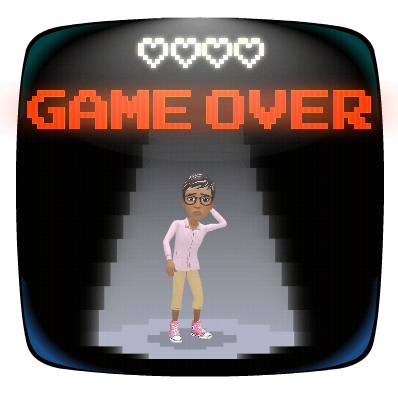
A game whose rules change after every move cannot be won by trying harder. My brain reached “Game Over” and I bolted north.
10
North for regulation; back because court was waiting
I drove to John O’Groats. Mum paid for two hotel nights so I could eat, shower and let my nervous system settle. Then I turned around because I still had to get to court.
By April 2025, I was back at Boldmere Court. Returning did not mean the bungalow had become accessible. It meant the available routes had narrowed until surviving there was the route left.
11
A right needs an accessible route
I repeatedly asked Talbots to review my evidence and to seek an autism and ADHD assessment through the court. Instead, they arranged a psychiatric assessment which, in my view, misunderstood neurodivergence and relied too heavily on disputed SMBC accounts. I ended their involvement in November 2025.
By August 2026 I was still asking the court in writing for suitable representation, written communication, a quiet waiting space, processing breaks, an advocate and a workable attendance route. Those requests did not produce the accessible participation route I had asked for. A theoretical right to representation is not the same as being understood or enabled to take part.
12
Do not perceive only the version that fits
I am a Late Identified AuDHD mixed race woman. Formal identification gave me the map I had spent a lifetime reverse-engineering: ReeOS.
Yet I still encountered staff who questioned ADHD and autism, treated articulate speech as evidence that I did not need support, or treated speech loss under overload as performance. Some individual staff were excellent. The wider route remained built around stereotypes rather than my actual communication and regulation needs.
Part four
Same Machinery, New Debt
Hospital, complaint, benefit and billing systems kept returning the work to me—often after the failure had already caused another injury or another debt.
13
Why does every request require another proof?
I sent messages about preventable injuries, housing risk and reasonable adjustments to PALS, NHS leadership and SMBC leadership. Too often, the response was silence, redirection or another instruction to approach a service that had already failed to act.
By 17 August 2026 I had completed West Midlands Police’s formal complaint form, setting out the period, people and allegations I wanted examined. That document records what I asked the police to investigate; it is not a police finding. One ignored message can be an error. Repeated disappearance across connected organisations is part of the system being mapped.
14
Access should not damage the equipment that provides it
In Cornwall, I went to hospital only a handful of times, mainly for routine needs or mental-health help—not because I kept falling. As soon as I returned to Sandwell, hospital visits multiplied.
My TriRide was damaged while I used it to push open heavy hospital doors so I could reach lifts and move between departments. When I asked SWBH to help with the repair costs, I was told the equipment was not designed to open heavy doors. The inaccessible doors remained; the damage and loss of mobility were left with me.
I had to learn to survive without reliable mental-health support, rehabilitation or physiotherapy. I finally accessed physiotherapy only after publicly challenging the gap on social media. Once again, support became reachable only after I made the failure visible.
15
One mindful cup
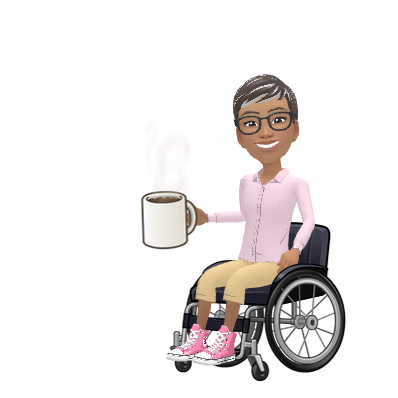
I still drink coffee, but now it is usually one cup a day—sometimes decaf when adding caffeine would be a mistake. I grind the beans and make that cup with purpose.
It is a tiny piece of ReeOS that survives every move: enough ritual to anchor the morning, enough attention to enjoy it, and no longer enough caffeine to prop up an impossible system from dawn until bedtime.
16
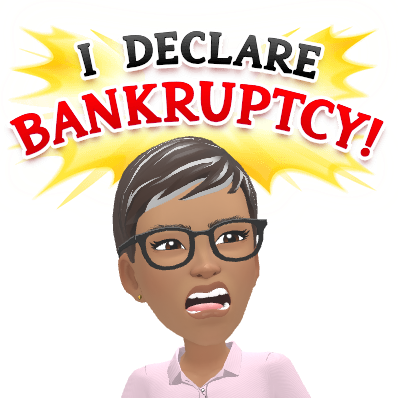
The picture says bankruptcy; the paperwork says DRO
On 30 October 2025, a Debt Relief Order cancelled approximately £5,000 of historic SMBC debt comprising rent, care charges and council tax—debt the council had not resolved despite years of dispute.
These were all living costs for which I had been trying to secure the financial help and reductions available through DWP and SMBC, yet I remained unable to unlock those basic entitlements. The DRO cleared the ledger, not the faulty machinery. Almost immediately, SMBC began filling the space with new liabilities: around £5,700 in council tax and nearly £1,000 in fresh care charges.
17
Can I have the money the system says I need?
A May 2025 council-tax reminder listed a full unsummonsed balance of £3,792.80. The new council-tax debt later reached about £5,700 while my request for council-tax help and the wider housing circumstances remained disputed.
SMBC also issued three new care invoices totalling £994.33 before the current financial-assessment and notification process had been completed. On 10 August 2026, Bev Mountain confirmed that they had been generated from an older assessment in error, cancelled them in full and returned that account to nil.
I was still asking DWP to resolve housing and disability payments, still asking for the fit-note route needed to stabilise benefits and still unable to unlock the substantial back payment I believe is due. The debt was not evidence that no help existed; it accumulated while the routes to that help remained inaccessible. Historic debt was cleared, and the same systems immediately began making new debt.
Part five
Life Cannot Wait for Sandwell
I am still pursuing the essentials. I am also building a life now, because postponing everything until every organisation behaves would mean postponing it forever.
18
The toilet frame: secured by Ree
In March 2026, I secured the toilet frame that Trish had ordered. Another essential item became safer because I found a workaround rather than because the adaptation system completed the job.
The frame did not resolve the unsafe shower, inaccessible sink, missing kitchen, garden steps or the rest of the bungalow. It was one necessary fix inside a home still described by me as uninhabitable.
19
I finally joined the WI
Mum and I had talked about joining the Women’s Institute since the film with the naughty calendar—not because of the calendar, but because they seemed like our kind of people.
Making, learning, organising, sharing skills and doing useful things together fit the life Mum and I value. I had kept putting it off until the Sandwell nonsense was resolved. Eventually I accepted that the nonsense was not ending soon enough, so life had to begin alongside it.
20
Mum finally experienced the loop beside me
In the week before this chapter was written in September 2026, Mum spent three consecutive days with me at hospital while we waited for the homelessness team. They did not come to see me, and I was discharged without the bungalow being reassessed.
Mum experienced the same pattern of waiting, redirection and missing follow-through that I had struggled to translate. She became angry enough to fund proper legal advice. That does not repair the failures, but it means I no longer have to unlock every legal route alone while the benefit money remains unresolved.
21
The dream is separate space within reach
I want a quiet, accessible place where Mum and I can each have our own space while remaining close enough to support one another when needed.
It might be a house for Mum with a small studio for me, or two accessible flats close enough that I can reach her. The shape matters less than the system: autonomy without isolation, support without engulfment, room for both of us to age without sacrificing one person to keep the other afloat.
That is my version of happy ever after: not rescue, but an environment in which care can flow both ways without consuming either life.
NOW
The story catches up with me here
There is no tidy ending yet.
I am still asking for safe housing, aids and adaptations, benefit corrections, accessible healthcare and a fair route through the legal processes. The bungalow remains uninhabitable in my account, and several disputes remain unresolved.
But recovery has changed the operator. I know I am AuDHD. I understand more of ReeOS. I have mapped the failures, preserved the records and stopped postponing every part of life until somebody else finally acts.
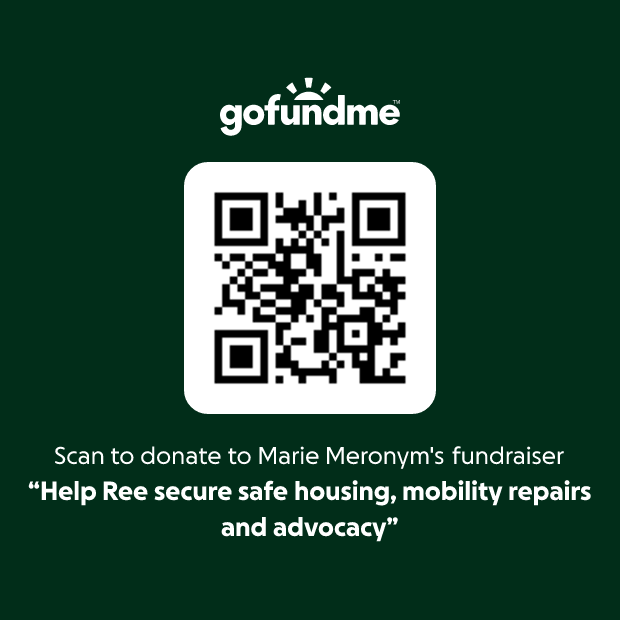
This chapter tells it in my own words and pictures. I am still trying to secure safe housing, mobility repairs and effective advocacy. Mum is now paying for legal help because I have been unable to unlock the support and back payments that should have helped.
If you would like to help us carry the cost of reaching the next chapter, you can donate or share the appeal.